Overwhelmed Mom? It's Not You. It's The Mental Load

The resets in this post are simple self-care tools. They are not a substitute for medical or mental health advice. Please reach out to a professional if you need more support.
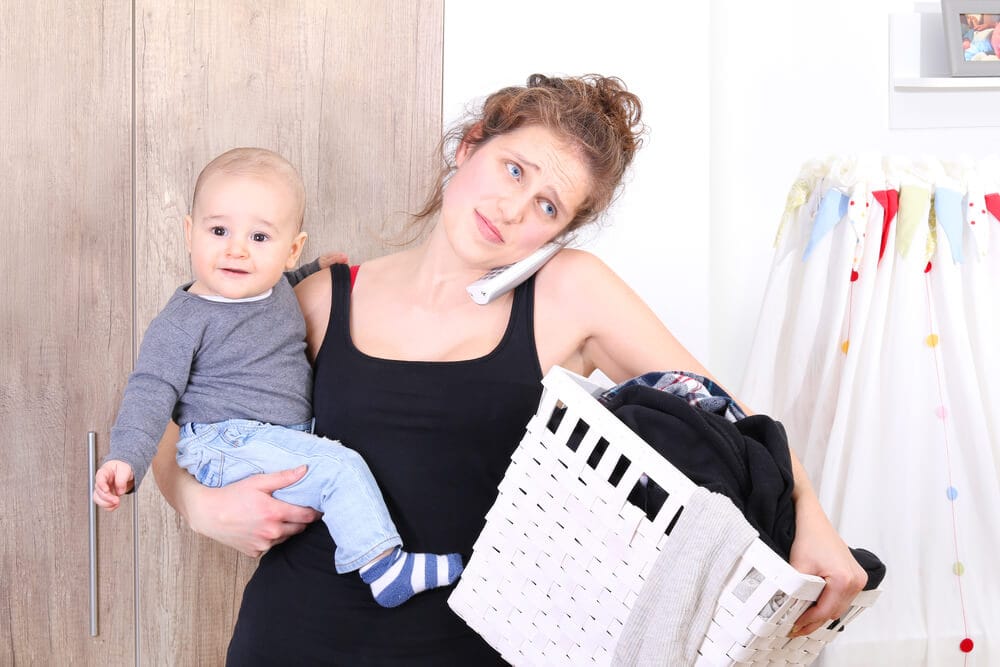
You’re getting the kids ready for school and notice they’re running out of clean clothes. You make a mental note to do the laundry after the school run. In the car, you’re thinking about what to make for dinner. Spaghetti and meatballs is a family favorite, but you’ll need to pick up more marinara sauce on the way home.
Groceries bought, you get back home, put the shopping away, and start the laundry. Then you notice the leaky faucet is dripping again. While you’re looking up plumbing companies online, your phone buzzes with an email: the permission slip for your youngest’s school trip is due tomorrow. You start rummaging around for the form when the washer beeps to let you know the wash cycle is done. Out of nowhere, you remember you need to buy a gift for the birthday party your kids are attending on the weekend. And suddenly, it’s all too much. There’s too much to remember and too much to do. You just freeze, not sure where to start.
That feeling, when everything piles up and your brain just stops, is overwhelm. And it doesn’t mean you’re disorganized or doing a bad job. It means you’re dealing with a lot. Not just with the physical tasks, but with the mental load of holding it all together.
What is “The Mental Load”?
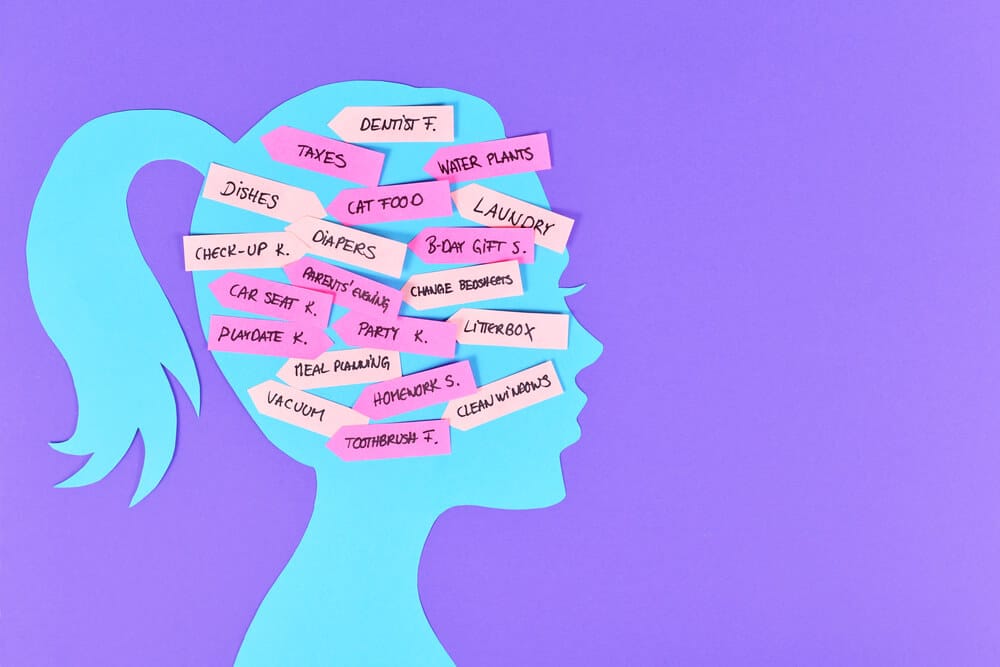
The mental load is the invisible work that goes into running a household. The term was popularized by the French cartoonist Emma in a comic strip titled “You Should’ve Asked,” but it has also been studied by scientists under the name “cognitive household labor.”
Sociologist Allison Daminger identified four different components of the mental load:
- Anticipating needs: recognizing there’s a need or problem. For example, noticing you’re low on marinara sauce, or that the laundry needs to be done.
- Identifying options: figuring out how to respond to the need. For example, researching local plumbers, or coming up with gift ideas.
- Making decisions: deciding which option to go with. For example, deciding which plumbing company to use or which gift to buy.
- Monitoring: making sure the decision is carried out and that it does what it needs to do. For example, remembering to go to the grocery store once you drop the kids at school, or making sure someone is home when the plumber is scheduled to arrive.
One of the moms Daminger interviewed as part of her research described the mental load as a “background job” that she’s always doing in her head, even while doing other tasks. But unlike a job you clock in and out of, the mental load never really stops. You might sit down for five minutes in the middle of the day and all of a sudden remember you need to refill a prescription. Or once you finally flop into bed, ready to fall asleep, you abruptly realize you need to schedule the kids’ annual checkups.
While research shows men are taking on more household labor than they were twenty years ago, Daminger found that moms carry more of the mental load. Out of the 32 couples she interviewed, women shouldered more of the mental load in 26 of them. Men took on more of the mental load in four couples, and the mental load was shared equally in just two. Anticipation and monitoring, in particular, were primarily undertaken by women.
What Does Carrying the Mental Load Cost?

A team of researchers studied how the mental load gets divided between moms and their partners and how this relates to their well-being. Their findings on the division of the mental load echoed Daminger’s, with the moms in their study reporting carrying more than their partners.
The researchers also found that moms who reported carrying more of the mental load reported higher levels of stress and burnout, as well as more depressive symptoms. Additionally, those moms reported lower levels of mental health and a lower quality romantic relationship.
Interestingly, the researchers did not find the same pattern when it came to physical household labor. Moms who reported having more responsibility for physical chores did not report higher levels of stress, burnout or depressive symptoms, nor did they report lower levels of mental health. They did, however, report a lower quality romantic relationship.
What explains the difference between the mental load and physical chores on moms’ reports of their mental health? The researchers think the way the mental load acts as a “background job” might be the key. Physical chores usually have an end point and completing them can give you a small sense of accomplishment. But the mental load never ends. It’s always there in the background, slowly draining your energy, without giving you the sense of satisfaction that comes from completing a physical task. And that is enough to make anyone feel overwhelmed.
Responding to Overwhelm From The Mental Load

So what do you do when you’re standing in the kitchen, brain frozen, feeling completely overwhelmed by the mental load? That's when a quick reset might be able to help. It won’t lessen the things you’re carrying, but it might help you regroup and find your footing again.
1-Minute Reset for Overwhelm
Let your eyes close or, if you prefer, simply lower your gaze to the floor, a few feet in front of you. Then take two deep breaths, where the exhale is longer than the inhale. Now bring your attention to your feet and just notice how the ground feels pushing against them. If your mind starts to wander, that’s okay. Just gently bring your attention back to your feet.
This is a mini mindfulness practice and research suggests that even short mindfulness exercises can help reduce stress and anxiety in the moment.
5-Minute Reset for Overwhelm
Find a pen and paper (or, if you prefer, open your notes app) and write down everything that is spiraling around in your head. Don’t worry about trying to organize it. Just focus on getting it out of your head and onto paper.
This activity may help you free up some mental space and give your brain room to breathe. Researchers found that students who wrote down their worries before taking a high-stakes test performed better. They suggested that writing down worries freed up space for the students to concentrate more on the test. Being a mom isn’t the same as taking an exam, but writing down what’s spiraling in your head may help you in a similar way to how writing down worries helped the students.
15-Minute Reset for Overwhelm
Find a coloring page you like and grab some pens. As you color, let yourself focus on the sensations of coloring. Notice how the pen feels in your hand and observe as the page fills with color. And if your mind starts to wander, gently bring it back to the experience of coloring.
Coloring is a mindfulness exercise in disguise. And research suggests that it may help to reduce anxiety and stress as well as improve mental well-being in the moment.
Concluding Thoughts
The mental load is the invisible work of running a household. It’s a never ending background job that is constantly draining your energy and attention away from other things. And sometimes, shouldering it can feel overwhelming. Next time you feel yourself freezing up from overwhelm, take a few minutes to try one of the resets and see if it helps. I’d love to hear about your experiences in the comments.
References
Aviv, Elizabeth, et al. “Cognitive Household Labor: Gender Disparities and Consequences for Maternal Mental Health and Wellbeing.” Archives of Womens Mental Health, vol. 28, 1 July 2024, https://doi.org/10.1007/s00737-024-01490-w.
Carsley, Dana, and Nancy L. Heath. “Effectiveness of Mindfulness-Based Coloring for University Students’ Test Anxiety.” Journal of American College Health, vol. 68, no. 5, 25 Mar. 2019, pp. 1–10, https://doi.org/10.1080/07448481.2019.1583239.
Daminger, Allison. “The Cognitive Dimension of Household Labor.” American Sociological Review, vol. 84, no. 4, 9 July 2019, pp. 609–633, https://doi.org/10.1177/0003122419859007.
Emma. “You Should’ve Asked.” Emma, 20 May 2017, https://english.emmaclit.com/2017/05/20/you-shouldve-asked/.
Fong, Janet Shuk Yan, et al. “Brief Mindful Coloring for Stress Reduction in Nurses Working in a Hong Kong Hospital During Covid-19 Pandemic: A Randomized Controlled Trial.” Medicine, vol. 101, no. 43, 28 Oct. 2022, p. e31253, https://doi.org/10.1097/md.0000000000031253.
Howarth, Ana, et al. “Effects of Brief Mindfulness-Based Interventions on Health-Related Outcomes: A Systematic Review.” Mindfulness, vol. 10, no. 10, 31 May 2019, pp. 1957–1968, https://doi.org/10.1007/s12671-019-01163-1.
Milkie, Melissa A, et al. “Who’s Doing the Housework and Childcare in America Now? Differential Convergence in Twenty-First-Century Gender Gaps in Home Tasks.” Socius: Sociological Research for a Dynamic World, vol. 11, 1 Jan. 2025, https://doi.org/10.1177/23780231251314667.
Morris, Rebecca. “A Screen-Free Break for Frazzled Moms (Mindfulness in Disguise).” Everyday Resets Club, 24 June 2026, https://www.everydayresetsclub.com/a-screen-free-activity-for-moms-who-feel-frazzled/.
Ramirez, G., and S. L. Beilock. “Writing About Testing Worries Boosts Exam Performance in the Classroom.” Science, vol. 331, no. 6014, 13 Jan. 2011, pp. 211–213, https://doi.org/10.1126/science.1199427.
Subscribe to receive your free Mini Menus & Mini Mood Booster!


Member discussion